Written by: CRGRT SimRacingPenguin
Few racing cars announce their arrival quite like the Chevrolet Corvette C5-R.
Before it even appears on screen, you can hear it: a deep, violent V8 rumble that sounds less like a conventional racing engine and more like an approaching thunderstorm. Then comes the unmistakable shape—a long bonnet, an enormous rear wing and a bright yellow body sitting impossibly low over wide racing tyres.
The Corvette C5-R was never subtle. It was loud, muscular and unapologetically American. It also became one of the defining GT racing cars of the early 2000s, both in real-world endurance racing and in the Gran Turismo series.
For an entire generation of players, the C5-R was more than another prize car. It was their introduction to Corvette Racing, the 24 Hours of Le Mans and the brutal world of long-distance GT competition.
A Corvette Built to Conquer the World
The C5-R was developed by General Motors and Pratt & Miller as the competition version of the fifth-generation Chevrolet Corvette.
Although it retained the recognisable proportions of the road-going C5, the racing version was a radically different machine underneath. It used a purpose-built racing chassis, heavily revised aerodynamics, enormous brakes and a naturally aspirated V8 designed to survive hours of flat-out competition.
Corvette Racing began competing with the C5-R in 1999. Its early appearances showed promise, but the programme quickly developed into one of the strongest operations in international GT racing.
At the 2000 24 Hours of Le Mans, the two factory C5-Rs finished third and fourth in the GTS category. Just one year later, Corvette Racing secured a commanding one-two class victory—its first official victory at Le Mans. (24h-lemans.com)
The C5-R would ultimately claim three Le Mans class victories, winning in 2001, 2002 and 2004. It also won the 2001 Rolex 24 at Daytona outright and helped Corvette Racing secure three consecutive American Le Mans Series GTS championships. (imsahalloffame.com)
Those results transformed the Corvette from a respected American sports car into a genuine international endurance-racing powerhouse.
The Car That Established Corvette Racing
Modern fans may associate Corvette Racing with the C6.R, C7.R, C8.R or the newer Z06 GT3.R, but the C5-R created the foundation upon which all of those cars were built.
It proved that an American front-engined sports car could travel to circuits such as Le Mans and defeat some of the finest European racing machinery in the world.
The C5-R battled cars including the Dodge Viper GTS-R, Ferrari 550 GTS, Saleen S7-R and Porsche 911-based racers. These were not lightweight demonstration events. They were physical endurance contests in which reliability, fuel strategy, tyre management and driver concentration mattered just as much as outright speed.
The Corvette had the power, but it also had the durability.
That combination became central to the Corvette Racing identity: unmistakable V8 performance supported by a disciplined, highly professional factory team.
The C5-R did not merely win trophies. It established the character of Corvette Racing for the following two decades.
The Famous Yellow No. 64 Corvette
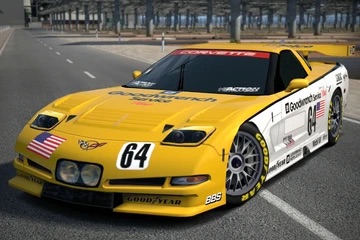
The version remembered most clearly by Gran Turismo players is the yellow No. 64 Corvette C5-R based on the car that competed at Le Mans in 2000.
Driven by Franck Fréon, Andy Pilgrim and Kelly Collins, the real No. 64 finished third in the GTS class and tenth overall. (24h-lemans.com)
Its appearance was perfect for a racing game.
The brilliant yellow paint made it instantly visible among a field of darker prototypes and touring cars. Its wide body, bonnet vents, side-exit exhausts and towering rear wing gave it the exaggerated proportions players expected from a serious racing machine.
Even people who knew little about endurance racing could immediately understand what the C5-R represented.
It looked powerful because it was powerful.
The Corvette C5-R in Gran Turismo 3
The Corvette C5-R made its Gran Turismo debut in Gran Turismo 3: A-Spec on the PlayStation 2.
Its inclusion came at exactly the right moment. Gran Turismo 3 was many players’ first experience of a new console generation, featuring smoother graphics, improved lighting and a greater sense of speed than its PlayStation predecessors.
Against that backdrop, the C5-R felt enormous.
It was one of the game’s memorable competition cars and could be earned as a prize, including for reaching 50 per cent game completion. It was also available as one of the potential prizes for the Super Speedway endurance event in certain versions of the game. (granturismo.neoseeker.com)
Receiving it felt significant. This was not simply a modified road Corvette wearing racing stickers. It was a genuine Le Mans machine with the power and visual presence to compete against the game’s fastest GT cars.
The C5-R also stood apart from the many Japanese racing cars that dominated Gran Turismo 3’s career mode. Surrounded by Skylines, Supras, NSXs and Lancers, the Corvette provided something completely different.
It was heavier in character, more aggressive in its power delivery and driven by an enormous naturally aspirated V8 rather than a highly tuned turbocharged engine.
That contrast made it unforgettable.
Returning in Gran Turismo 4
The C5-R returned in Gran Turismo 4, appearing alongside one of the largest and most diverse collections of cars ever assembled for a racing game. Official and regional car lists confirm the Corvette C5-R as part of the game’s roster. (GTPlanet)
Gran Turismo 4 gave players more opportunities to place the car in an appropriate environment.
Tracks such as Circuit de la Sarthe allowed the C5-R to return virtually to Le Mans. Players could send it down the Mulsanne Straight, brake heavily into Arnage and experience a recreation of the circuit where the real car had built its reputation.
The game also included longer races, tyre wear, fuel consumption and pit stops. These systems made endurance cars feel more meaningful. Instead of using the Corvette only for a short sprint, players could recreate something closer to its intended purpose.
The C5-R was not always the most technologically advanced car in the garage. Prototypes were faster, while some lighter GT machines could be easier to handle. However, the Corvette’s combination of stability, speed and immense torque made it satisfying across a wide variety of circuits.
More importantly, it had personality.
Plenty of cars in Gran Turismo 4 were fast. Far fewer felt as memorable.
Gran Turismo PSP, Gran Turismo 5 and Gran Turismo 6
The Corvette continued its virtual career in Gran Turismo for PSP, where it appeared on the official featured-car list. (gran-turismo.com)
It later returned in Gran Turismo 5 and Gran Turismo 6, although it remained a lower-detail “Standard” model rather than receiving the fully remodelled interior and exterior treatment given to the games’ Premium cars.
Its presence in GT5 and GT6 is confirmed by the official Gran Turismo car lists. (Gran Turismo)
This created a slightly bittersweet situation for longtime fans.
The C5-R was still available to drive, but its older model visibly showed its PlayStation 2 origins when placed beside newer Premium cars. Its simplified interior and dated textures prevented it from receiving the full modern presentation it deserved.
Even so, many players continued to use it.
The sound, shape and history remained powerful enough to overcome its graphical limitations. It could still be tuned, raced and photographed, while newer Corvette race modifications in the games used yellow liveries clearly inspired by the classic C5-R design.
The car’s mainline Gran Turismo run stretched from Gran Turismo 3 through Gran Turismo 6, with an additional appearance in the PSP game. However, the original C5-R itself did not return as a driveable car in Gran Turismo Sport or Gran Turismo 7.
Its absence has only increased the desire to see it recreated as a fully detailed modern model.
Why It Was So Satisfying to Drive
The C5-R appealed to players because it felt powerful without being completely inaccessible.
It delivered huge straight-line performance, but it was not merely a high-speed missile. Its racing suspension, wide tyres and aerodynamic bodywork gave it the grip necessary to use that performance effectively.
The long bonnet and front-engined layout produced a different sensation from the mid-engined prototypes and supercars surrounding it. You could feel the mass of the car during direction changes, yet it remained planted and predictable when driven smoothly.
Its V8 torque made corner exits especially satisfying. The driver did not need to wait endlessly for a turbocharger to come alive. Pressing the accelerator produced an immediate surge accompanied by one of the most distinctive engine notes in the series.
That accessibility mattered.
The C5-R was fast enough to feel special, demanding enough to reward practice and forgiving enough that less experienced players could still enjoy it.
It occupied the perfect middle ground between a tuned road car and an intimidating Le Mans prototype.
An Unmistakable Sound
A major part of the Corvette’s popularity has always been its soundtrack.
Many racing cars sound highly engineered, precise and almost clinical. The C5-R sounds physical.
Its low-frequency V8 note carries a sense of weight that smaller engines struggle to replicate. At idle it rumbles. Under acceleration it becomes a thunderous roar. During downshifts it produces the kind of mechanical drama that makes even an ordinary braking zone feel like an event.
For Gran Turismo players using basic television speakers, that sound was often their first indication that the C5-R was different.
For players using a proper sound system, it could dominate the entire room.
The engine note became inseparable from the car’s identity. The Corvette did not need to be visible to be recognised.
A Shape That Could Never Be Mistaken
The C5-R also arrived during an era when GT racing cars still strongly resembled the road cars from which they originated.
It was obviously a racing machine, but it was just as obviously a Corvette.
The pop-up-headlight-era C5 silhouette remained intact. The long front end, low roofline and short rear deck were exaggerated rather than erased. Chevrolet’s designers and Pratt & Miller created a car that looked like the road-going Corvette had been stretched, widened and turned into a weapon.
That connection helped fans relate to it.
A Le Mans prototype could appear distant and otherworldly. The C5-R looked like an extreme version of something a person might actually see on the road.
It represented the fantasy at the heart of GT racing: taking a recognisable sports car and pushing it to the absolute limit.
The Rivalries Made It Better
Great racing cars are often defined by their opponents, and the C5-R competed during a spectacular period for GT machinery.
Its early rivalry with the Dodge Viper GTS-R gave American motorsport fans a battle between two completely different interpretations of the front-engined V10 and V8 supercar.
Later, the Corvette faced cars such as the Prodrive-built Ferrari 550 GTS. The Ferrari was elegant, exotic and European. The Corvette was loud, aggressive and unmistakably American.
Gran Turismo allowed players to continue these battles long after the real cars had retired.
The C5-R could be raced against Vipers, Ferraris, Porsches, Saleens and Japanese GT500 machines. These matchups were not always historically exact, but they captured the excitement of an era in which manufacturers created dramatically different machines to pursue the same objective.
More Than Nostalgia
It would be easy to explain the C5-R’s continued popularity as simple nostalgia.
That is certainly part of it. Players who first encountered the car in Gran Turismo 3 or Gran Turismo 4 naturally associate it with childhood memories, early PlayStation 2 racing and the excitement of unlocking a genuinely powerful competition car.
But nostalgia alone does not explain why the C5-R remains so respected.
The real car earned its reputation.
It won at Daytona, conquered its class at Le Mans and established one of the most successful factory GT racing programmes of the modern era. Its design remains instantly recognisable, while its naturally aspirated V8 represents a type of racing car that is becoming increasingly rare.
The C5-R is loved because its appearance, sound, performance and history all support one another.
There is no artificial legend surrounding it. The car was genuinely that good.
Why the C5-R Deserves to Return in Gran Turismo 7
Gran Turismo 7 celebrates automotive history through highly detailed models, museum entries and cars drawn from almost every major period of motorsport.
That makes the continued absence of the Corvette C5-R particularly noticeable.
A modern recreation could finally give the car the treatment it never received in Gran Turismo 5 or Gran Turismo 6: a fully modelled racing interior, accurate digital instruments, detailed bodywork and a high-quality recreation of its thunderous V8.
It would also fill an important historical gap between the production Corvettes and the later generations of Corvette Racing machinery.
The C5-R is not merely another old GT car. It is the machine that launched the modern Corvette Racing dynasty.
Bringing it back would allow longtime fans to revisit one of the series’ most memorable race cars while introducing younger players to the Corvette that conquered Le Mans and helped reshape international perceptions of American sports-car racing.
A Racing Car With a Soul
The Chevrolet Corvette C5-R is one of the most loved racing cars ever because it combined genuine success with an extraordinary amount of character.
It had the results to earn respect, the appearance to become instantly recognisable and the sound to turn casual viewers into fans. In Gran Turismo, it offered players something equally important: the opportunity to experience a real endurance-racing icon from their own homes.
For many, the C5-R will always be remembered tearing around Trial Mountain, powering down the Mulsanne Straight or appearing unexpectedly on the Gran Turismo 3 prize-car screen.
It represents a period when racing cars were loud, visibly mechanical and wonderfully distinctive.
The Corvette C5-R did not whisper its way into motorsport history.
It arrived with a yellow body, an enormous rear wing and the unmistakable roar of an American V8—and more than two decades later, players are still listening.
Author: Samuel Feinberg
Copyright © Samuel Feinberg 2026–2027. All rights reserved. This article is original content. No unauthorised reproduction or AI training usage is permitted.


Leave a Reply