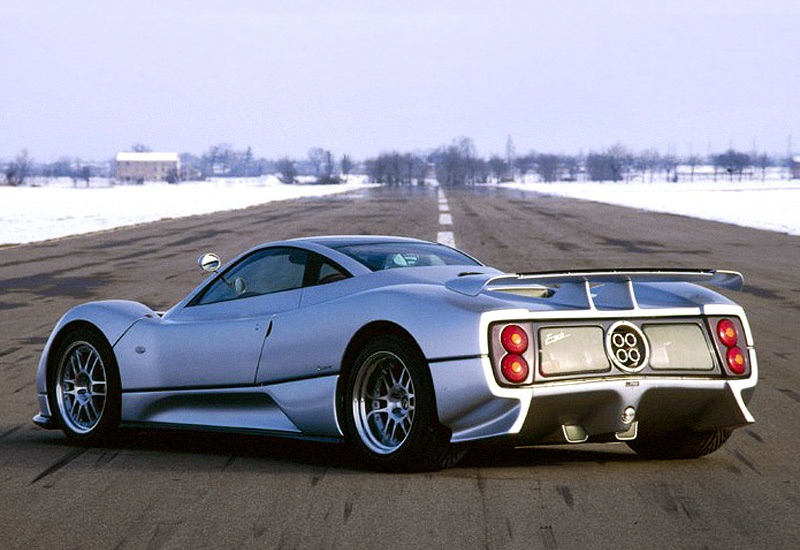
When enthusiasts talk about the greatest supercars ever created, names like the Ferrari F40, McLaren F1 and Porsche Carrera GT usually dominate the conversation. Yet one car quietly carved out its own legendary status through craftsmanship, engineering and unmistakable design—the Pagani Zonda C12.
Introduced at the 1999 Geneva Motor Show, the Zonda C12 marked the birth of Pagani Automobili and instantly proved that a small Italian manufacturer could compete with the world’s automotive giants. (Wikipedia)
A Dream Built by Horacio Pagani
Before founding Pagani Automobili, Horacio Pagani worked at Lamborghini, where he became one of the industry’s pioneers in carbon fibre technology. Believing lightweight composite materials represented the future of supercars, he left to establish his own company and pursue his vision.
The result was the Zonda C12—a machine designed around the philosophy that a car should be both an engineering masterpiece and a work of art. Every curve, vent and carbon fibre component served a purpose while creating one of the most recognisable silhouettes in automotive history. (Pagani)
Mercedes-Benz V12 Power
Powering the original Zonda C12 was a naturally aspirated 6.0-litre Mercedes-Benz M120 V12, producing up to 450 horsepower and 590 Nm of torque depending on specification.
Performance figures included:
- Engine: 6.0-litre naturally aspirated Mercedes-Benz V12
- Power: 450 hp
- Torque: 590 Nm
- Transmission: 5-speed manual
- Drivetrain: Rear-wheel drive
- 0–100 km/h (62 mph): Around 4.2 seconds
- Top speed: Approximately 298 km/h (185 mph)
Unlike many modern hypercars that rely on turbochargers or hybrid assistance, the C12 delivered a wonderfully linear powerband accompanied by one of the greatest V12 soundtracks ever produced. (Wikipedia)
Carbon Fibre Before It Was Fashionable
In 1999, widespread use of carbon fibre was still relatively uncommon outside Formula One and a handful of exotic manufacturers.
Pagani made it the centrepiece of the Zonda.
The lightweight carbon fibre monocoque chassis gave the car exceptional rigidity while keeping weight to roughly 1,250 kg, helping maximise performance, agility and driver engagement. Even today, the engineering remains remarkably advanced for a car introduced over 25 years ago. (Pagani)
An Interior Like No Other
Step inside a Zonda C12 and you’re greeted by an environment unlike anything from Ferrari or Lamborghini.
Exposed aluminium components, beautifully machined switchgear, polished metal details and handcrafted leather combine to create an interior that feels more like a luxury watch than a conventional sports car.
Every surface reflects Pagani’s obsession with detail, demonstrating that performance and craftsmanship can coexist perfectly.
Extremely Rare
The original C12 is among the rarest Paganis ever built.
Only five examples were produced with the original 6.0-litre engine before Pagani introduced the more powerful C12 S. One chassis served as the crash-test and homologation vehicle, while another became the company’s demonstrator, making customer cars exceptionally scarce today. (Wikipedia)
Why the Zonda Became a Legend
The Zonda didn’t rely solely on raw speed to become famous.
Instead, it offered something increasingly rare:
- Naturally aspirated V12 emotion
- Manual transmission involvement
- Lightweight construction
- Hand-built craftsmanship
- Timeless styling
Even after the Huayra and Utopia arrived, Pagani continued producing bespoke Zonda variants for select customers—proof that the original design remains one of the most celebrated supercars ever created. (Wikipedia)
Final Thoughts
The Pagani Zonda C12 wasn’t simply another exotic car—it established an entirely new standard for boutique supercar manufacturers. Horacio Pagani combined aerospace engineering, artistic design and old-fashioned craftsmanship into a machine that still turns heads decades after its debut.
Many faster cars have followed, but very few have captured the imagination quite like the original Zonda. Its naturally aspirated V12, carbon fibre construction and breathtaking attention to detail ensure it remains one of the greatest automotive icons ever built.


Leave a Reply